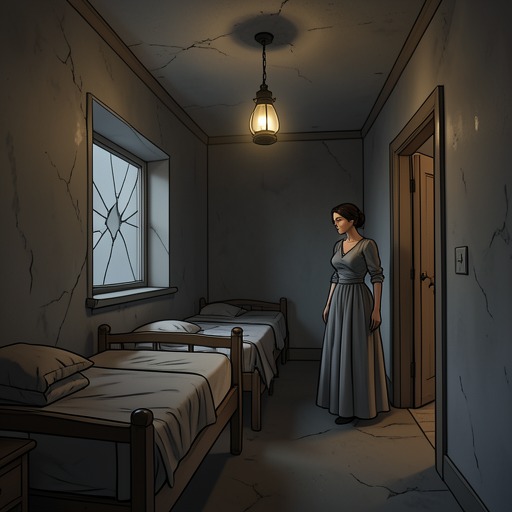
Ireland’s Magdalene Laundries
Small Things Like TheseIreland’s Magdalene Laundries were institutions where women and girls were concealed, incarcerated, and forced to labor, often with little public recognition of their work or the lives taken from them. Small Things Like These brings the system into view through a local laundry whose respectable reputation coexists with rumors of coercion, and through an afterword that records the broader institutional history, human cost, and belated public accountability.
Nature and Public Reputation
In the novel’s New Ross, the Good Shepherd Sisters run a training school for girls as well as a laundry business. The school is described publicly as providing basic education, while the laundry supplies restaurants, guesthouses, a nursing home, a hospital, priests, and well-off households. Its work is praised for returning everything in excellent condition, whether a large batch of bedlinen or a dozen handkerchiefs. That dependable service gives the institution an ordinary and respected place in the town’s economic life.
The town’s account of what happens inside is less settled. Some residents say the so-called training-school girls are not students but girls judged to be of low character, made to do penance by washing dirty linen from dawn until night. A local nurse is said to have treated a fifteen-year-old who developed varicose veins from standing so long at the wash-tubs. Other stories attribute the punishing work to the nuns, describing them as overworked knitters and rosary-bead makers, restricted to prayer and silence and fed sparingly until their work is done. The competing accounts do not amount to a single verified description of life inside the convent; the narration explicitly warns that much town gossip cannot be trusted.
Confinement, Labor, and Separation
The most consequential rumors concern unmarried girls sent away after giving birth. According to what some townspeople say, families put these girls in the institution to hide them, while their babies were adopted by wealthy Americans or sent to Australia; the stories further allege that the nuns profited from placing infants abroad. The narrative presents these claims as circulating talk rather than establishing every detail as fact. Their presence nevertheless reveals how the institution is imagined by the community: not simply as a place of work or instruction, but as part of a system that could remove both unmarried mothers and their children from public view.
The novel gives that concealed separation an immediate human form when a girl asks Bill Furlong to inquire about her baby. She says the infant is fourteen weeks old, has been taken from her, and may be hungry; she does not know where he is. Her plea makes the cost of separation concrete without turning the town’s unverified accounts into a complete record of this particular institution. When Furlong later finds her sitting without food while a young nun cooks, the girl is in a daze. He pauses beside her and offers help, and she begins to cry. The scene contrasts the institution’s public order and charitable appearance with a young mother’s uncertainty about the child from whom she has been separated.
Institutional Power and Community Complicity
The convent’s influence does not depend only on what can be seen within its walls. The laundry’s customers rely on its work, and its payments matter to local businesses. After Furlong recounts what he witnessed, Eileen Furlong argues that the matter has nothing to do with them, points to the girls’ need for firewood, and stresses that the nuns pay their bills on time. Her response registers both practical dependence and the pressure to treat the convent as an ordinary, useful institution rather than confront the treatment of the girls. Furlong’s own reflection that he was raised far from hardship sharpens the contrast between his relative security and the vulnerability of girls who have become pregnant outside marriage.
The institution’s authority is also visible in the Christmas encounter with the Mother Superior. She gives Furlong an envelope and says she expects an invoice for what is owed, presenting the exchange as a routine payment and seasonal gift. After escorting him toward the kitchen, she and the others expect him to leave. Instead, he stops beside the girl and asks whether he can do anything for her. The turn from invoice and payment to a direct offer of care shifts attention from the convent’s respectable transactions to the person its routines have left without food or a known place for her child.
Historical Record and Accountability
The note on the text distinguishes the fictional story from the historical record: the work is not based on any individual person. It states that Ireland’s last Magdalen laundry did not close until 1996 and that the number of women and girls concealed, incarcerated, and forced to labor is unknown. Ten thousand is offered as a modest estimate, while thirty thousand is described as probably more accurate. Many institutional records were destroyed, lost, or made inaccessible, and the work of women and girls was rarely acknowledged. The note also records that many lost their babies, some lost their lives, and some or most lost the lives they might otherwise have had.
The account places the laundries within a wider institutional landscape. It reports that the Catholic Church and the Irish State ran and financed these institutions in concert. It also notes the harms associated with mother-and-baby homes: the number of infants who died or were adopted out is unknown, while the Mother and Baby Home Commission report found that nine thousand children died in eighteen institutions it investigated. These figures concern the homes and the broader system described in the note; they should not be mistaken for a count of deaths in the laundries alone.
The note records two specific points of public reckoning. In 2014, historian Catherine Corless made public her finding that 796 babies had died at the Tuam home in County Galway between 1925 and 1961. The Irish government did not apologize for the Magdalene laundries until Taoiseach Enda Kenny did so in 2013. The late dates of discovery and apology, set beside the long operation of the institutions and the loss or inaccessibility of records, make the limits of retrospective accounting part of their history.
Narrative Significance
Small Things Like These sets the laundry’s immaculate output against the uncertain and damaging accounts of the people who may have produced it. The town can verify the clean linen arriving back from the convent more readily than it can know what happens to the girls inside. That imbalance turns everyday reliance, gossip, and silence into parts of the institution’s social power: the laundry is useful to many people, while the girls’ experiences are easier to dismiss as rumor or as a matter belonging to someone else.
The novel’s epigraph invokes the 1916 Proclamation of the Irish Republic and its promise to cherish all the children of the nation equally. The story’s attention to a separated infant and a young mother asking for help places that public ideal beside the unequal protection the institutions and their surroundings actually provide. In the final walk with the girl, Furlong wonders whether a person can go through life without being brave enough to oppose what is there and still call himself a Christian. The question gives the laundries’ history its moral force in the narrative: knowledge of injustice matters, but so does the decision to answer a particular person’s need.